Cuckoos: Outsourcing Childcare, Hogging the Bed

(Via:)
(Via: Batsby)

Common Name: Parasitic Cuckoos

A.K.A.: Subfamily Cuculinae (Family Cuculidae)

Vital Stats:

  • Range in length from 15-63cm (6-25”) and weigh between 17g (0.6oz.) and 630g (1.4lbs.)
  • The majority of cuckoos are not parasites, but around 60sp. are (about 56 in the Old World, and 3 in the New World)
  • Babies of brood parasites are initially coloured so as to resemble the young of the host species

Found: The cuckoo family is present throughout the temperate and tropical world, with the exceptions of southwest South America and regions of North Africa and the Middle East. Parasitic cuckoos occupy a subset of this range, principally in the Old World.
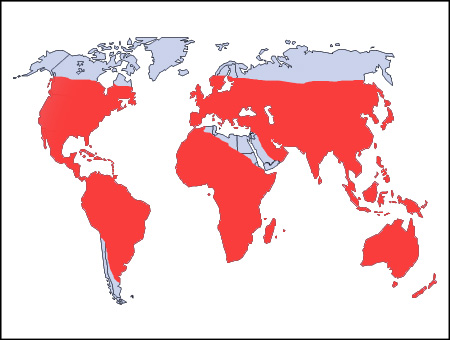
Cuckoo Map

It Does What?!

Parenting is tough… less sleep, less free time, all those all those hungry mouths to feed. What’s a busy mother to do? You know you need to perpetuate the species, but who has the time? Impressively, cuckoos have come up with the same answer that many humans have: outsourcing! Involuntary outsourcing, in this case.
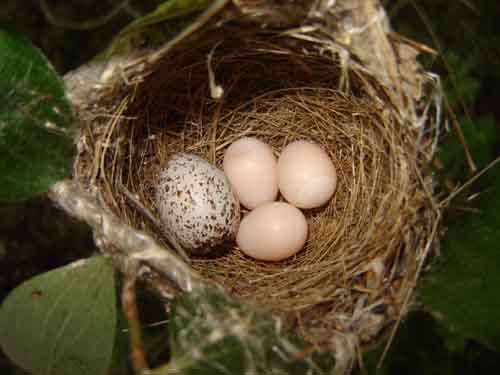
One of these things is not like the others.(Via: Timothy H. Parker)
One of these things is not like the others.
(Via: Timothy H. Parker)

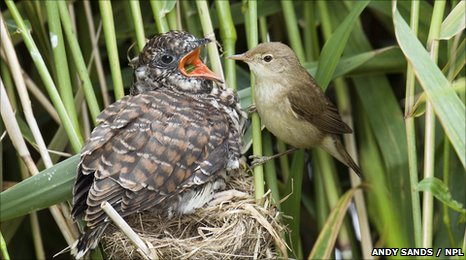
Once a female cuckoo has mated and is ready to lay the eggs, rather than build a nest and slog her way through childcare, she waits for another female with freshly laid eggs to take off for some food and just lays her egg there, spreading her clutch across several nests. In theory, when the duped female returns, she’ll just settle in and care for the new egg along with her own. Cuckoo eggs have a shorter incubation period than that of their host, so the foreign egg usually hatches first, at which point the baby cuckoo just gives the other eggs (or chicks, if the timing didn’t quite work out) a good shove, and enjoys having both a nest and a doting mother to itself. The cuckoo chick will tend to grow faster than its host species, so it keeps its adoptive parent busy with constant begging for food, having eliminated the competition.

But this wouldn’t be a fun evolutionary arms race if the host species just took it on the chin. Birds plagued by cuckoo eggs have worked out several ways to try to cope with the problem. First off, and not surprisingly, they’ve developed a burning hatred of cuckoos. Adult cuckoos seen in the area of the hosts’ nests will immediately be mobbed and run off by a group of angry mothers. The cuckoos, however, have learned to use this to their advantage by having the male of a pair tease and lure the angry mob away while the female lays her eggs in peace. Advantage: cuckoos.

And this, kids, is how you deal with those annoying younger siblings.(Via: M. Bán, PLoS ONE)
And this, kids, is how you deal with those annoying younger siblings.
(By: M. Bán, PLoS ONE)

A second strategy used by the parasitised birds is to learn to recognise foreign eggs and pre-emptively toss them out of the nest. Cuckoos responded to this in two ways. First, they slowly evolved eggs to match those of their host bird in colour and size (or, in the case of covered nests, very dark eggs which aren’t easily seen at all). Bird species with higher levels of egg rejection just end up with cuckoo eggs which look more and more similar to their own. Second, if a host does reject the foreign egg, the cuckoo who laid it will sometimes come and just destroy the entire nest, killing anything left inside it in an act of motherly vengeance. Advantage: cuckoos.

A third strategy, developed by the Superb Fairy Wren (not to be confused with the equally floridly named Splendid Fairy Wren) is a bit more clever. As soon as the host mother lays her eggs, she begins to sing to them in a very specific pattern. Now, in this case, the cuckoo egg will hatch around the same time as her own eggs, but was deposited there several days later than her own. This means that her own chicks have been sitting there, unborn, learning her song for a longer period of time than the cuckoo has. Once the eggs are hatched, only her own chicks will be able to properly replicate her calls. Can’t sing the song? No food for you. And if, prior to starving to death, the parasite chick does manage to push her chicks out of the nest, the mother will fail to hear the proper response at all and know to simply abandon the nest entirely. Advantage: Fairy Wren. Superb indeed.

Shrikes: don't try to outsmart a bird that kills mammals for sport.(Via: Arkive.org)
Shrikes… don’t try to outsmart a bird that kills mammals for sport.
(Via: Arkive.org)

There is at least one known case of a former host species throwing off the yoke of cuckoo parasitism entirely. The red-backed shrike, aside from being particularly murderously aggressive toward adult cuckoos (and many other things), became very good at identifying cuckoo eggs, very quickly. So quickly, in fact, that researchers believe the cuckoos simply didn’t have time to adapt. In laboratory experiments, the shrikes correctly identified and rejected 93.3% of all cuckoo eggs placed in their nests. Pretty good pattern recognition for a brain the size of a pea. While cuckoo-red shrike parasitism has been known historically for some time, it hasn’t been seen in nature for the last 30-40 years.

Shrikes for the win.

Fun Facts:

  • Even typically non-parasitic cuckoos will sometimes lay their eggs in the nests of their own or other species, but will still help to feed the chicks (parental guilt, perhaps?).
  • The eggshells of parasitic cuckoos are unusually thick, helping prevent them from cracking as their mother drops them from above into the host nest.
  • Striped cuckoos, not content to just shove their adoptive siblings out of the nest, actually peck them to death with their beaks.
  • A few birds deal with homicidal cuckoo chicks by building steep-sided nests, making it difficult for any chick to be pushed out (and raising them as one big, happy family, I guess).

Says Who?

  • Colombelli-Négrel et al. (2012) Current Biology 22: 2155-2160
  • Feeney et al. (2012) Animal Behaviour 84: 3-12
  • Lovaszi & Moskat (2004) Behaviour 141(2): 245-262
  • Spottiswoode & Stevens (2012) American Naturalist 179(5): 633-648
  • Wang & Kimball (2012) Journal of Ornithology 153: 825-831

The Devil You Know, the Devil You Don’t

(Via: Wikimedia Commons)

Common Name: The Tasmanian Devil

A.K.A.Sarcophilus harrisii (Family Dasyuridae)

Vital Stats:

  • Latin name translates to “Harris’s Meat Lover” after naturalist George Harris
  • Weigh 6-13kg (13-29lbs.), around the size of a small dog
  • Largest carnivorous marsupials in the world after the extinction of the thylacine in 1936
  • Live up to five years in the wild; fully grown at two years of age

Found: On the Australian island-state of Tasmania

Devil Map

It Does What?!

Spins around in circles and chases talking rabbits, if the cartoons are to be believed. But Tasmanian devils have suffered from some bad press over the years. While they’re often portrayed as incurably vicious, dangerous creatures, this isn’t really the whole truth. Yes, they can scream like a person getting dismembered. And yes, they’re good little hunters that can take down prey larger than themselves, partly thanks to having the strongest bite per unit body mass of any living mammal. (Crunching through large bones is not a tall order for a Tasmanian devil.) But they just as often scavenge carrion killed by other causes, frequently in the form of roadkill. They don’t tend to attack humans, either (unless that human happens to be dead already). Faced with live humans, devils will usually just hold still and hope you don’t see them, sometimes trembling nervously as they do so. Doesn’t exactly strike fear into your heart, does it?

caption(Via:)
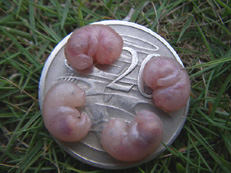
How many newborn devils CAN you fit on a 20 cent piece?
(Via: 500 Questions)

In fact, more than anything, devils deserve a bit of sympathy (just ask the ‘Stones)… life is tough for them right from the word ‘go.’ You see, Tasmanian devils are marsupial, meaning the young are born very under-developed and must crawl from the birth canal into their mother’s pouch to find a nipple to latch onto while they finish baking. The problem here is, devils give birth to between twenty and thirty babies, but possess only four nipples, which aren’t shared. In fact, they’re effectively stuck in the infant’s mouth from the time they latch on, preventing them from falling out of the mother’s pouch. So as newborn babies, fresh from the womb, they already have as much as an 87% chance of immediate death. That is some harsh selection right there. Somewhat tellingly, the babies can’t open their eyes until three months after their birth, yet come out of the womb with a full (if small) set of claws. You can see where evolution’s priorities were here.

But it doesn’t get much easier for the four that win the nipple race. Tasmanian devils are already working with a rather restricted range, having been hunted to local extinction on mainland Australia around 3000 years ago (probably by dingoes, which aren’t found in Tasmania). Nevertheless, they were doing pretty well in keeping their numbers up and had a healthy population until the mid-90s, when disaster struck.

caption(Via: Wikimedia Commons)
Don’t image-search this disease… it gets so much worse.
(Via: Wikimedia Commons)

Because the entire Tasmanian population of devils was originally based on only a few individuals, they’ve experienced a ‘Founder Effect,’ which basically means that the genetic diversity from one animal to the next is quite low. In terms of disease, they’re all susceptible to the same things. So when a form of transmissible cancer known as Devil Facial Tumour Disease (DFTD) suddenly popped up in 1996, it spread like wildfire from one devil to the next, mostly via their tendency to bite one another during sex and mealtimes.

An infected devil quickly develops tumours on its face and inside its mouth. This eventually makes it difficult to eat, leading to starvation within a year of contracting the disease. DFTD is estimated to have already killed up to 50% of all devils, rushing them from a healthy population to an endangered species in record time. While the government has taken the step of building up a healthy, captive population which will be isolated from the disease, in the long term, this will have the effect of reducing the species genetic diversity even further. As a small glimmer of hope, researchers are now reported to have found a few individuals with at least partial immunity to the disease, and hope to try to build a cure based on their physiology.

caption(Via:)
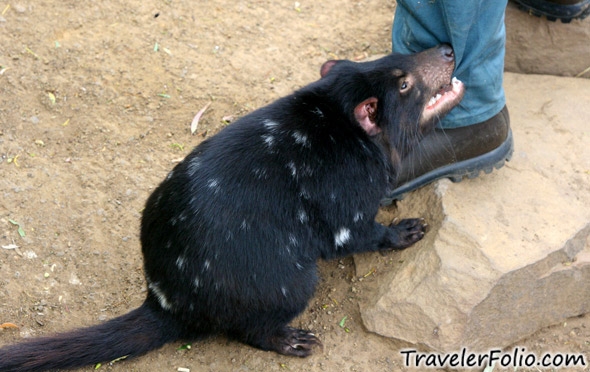
Bitey the Devil picks a fight.
(Via: TravelerFolio)

Fun Facts:

  • Tasmanian devils store fat reserves in their tails… a fat-tailed devil is a healthy devil.
  • See the white spots on the devil pictured above? All bite marks. Each scar leaves a patch of white fur. The natural white streak on the devil’s thick-skinned chest is thought to draw attacks away from more sensitive areas.
  • Unlike most other marsupials, the devil’s pouch opens to the rear of her body rather than the front (like a kangaroo), making it impossible for her to interact with her babies while they’re nursing there.
  • Devils tend to try to eat whatever’s available when they’re hungry. The following have been found in their droppings: steel wool pot scrapers, tea towels, parts of leather shoes, blue jeans, plastic fragments, dog collars (minus the unfortunate dog that had been in it), and echidna spines.
  • The only other known form of non-viral, transmissible cancer is a type of venereal disease that occurs in dogs.

Says Who?

  • Attard et al. (2011) Journal of Zoology 285: 292-300
  • Coghlan (2012) “’Immortal’ Tasmanian devil brings vaccine hope” New Scientist, 17 February
  • Grzelewski (2002) Smithsonian 68: February
  • Hamede et al. (2013) Journal of Animal Ecology 82: 182-190
  • Hesterman et al. (2008) Journal of Zoology 275: 130-138
  • Marshall (2011) “Tasmanian devils were sitting ducks for deadly cancer” New Scientist, 27 June