Charity Among Vampires

(Via: National Geographic)

Common Name: The Vampire Bat

A.K.A.: Subfamily Desmodontinae

Vital Stats:

  • Subfamily contains three species; the common vampire bat (Desmodus rotundus), the hairy-legged vampire bat (Diphylla ecaudata), and the white-winged vampire bat (Diaemus youngi)
  • All three feed only on blood, a phenomenon known as hematophagy
  • The common vampire bat feeds primarily on mammals, while the other two species prefer avian blood
  • Can live up to 20 years in captivity

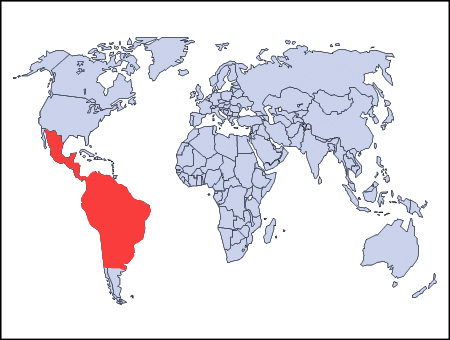
Found: Throughout Mexico, Central America, and all but the most southern reaches of South America
It Does What?!

Several years ago while on a botanical expedition in the rainforests of South America, I woke one morning to find that one of the other team members, still fast asleep in his hammock, had – apparently – been stabbed in the shoulder during the night. A surprising amount of blood had run down his arm, and yet he snored peacefully away. What the hell had happened to this guy, and was he the world’s deepest sleeper, or what?

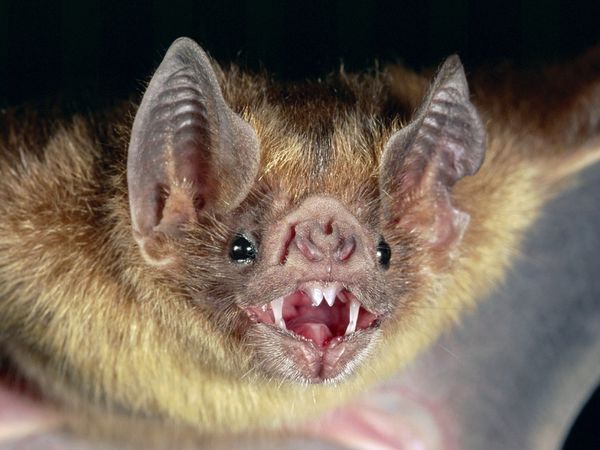
Nope. Turns out he had just unwittingly provided a good meal for Desmodus rotundus… the common vampire bat.

As horrifying as it may seem to have flying vermin drinking your blood whilst you sleep, it’s really not as bad as pop culture would have us believe. The bats are more scavenger than predator. To begin with, they prefer stealth and guile to any kind of open attack. Sleeping animals are best, and victims are never approached from the air, Caped Crusader-style. Instead, the bat will land nearby and walk on all-fours over to its prey. From there, it uses heat sensors in its nose (similar to some snakes) to detect where blood vessels pass close to the surface of the skin. In cows, another favourite blood donor of Desmodus, bites are usually just above the hooves or around the ears.

Breakfast of Champions
(Via: National Geographic)

Also contrary to popular belief, the bites are never violent; they’re more like a tiny nick from a very sharp razor- painless, but they tend to bleed a lot. In this case, they’re bleeding a lot because the bat’s saliva contains anticoagulents, preventing the blood from clotting. The bat will lap at the cut with its tongue (no blood-sucking here), transferring saliva into the wound, which will sometimes continue to bleed for hours afterward.

An entire feeding session takes the bat only about 20 minutes, during which time it can consume up to half its own weight in blood. How is this possible? Vampire bats have an amazingly efficient excretory system; the plasma (liquid) portion of the blood is immediately absorbed and passed through the kidneys. Within minutes of beginning to feed, the vampire starts to pee at the same time, and continues to do so until its meal has been reduced to a manageable volume. (Did they leave this part out of the Twilight movies?)

Creepy as these little beasts may seem, they have a surprisingly enlightened social structure. Vampire bats have been cited by animal behaviourists as one of the few examples of reciprocal altruism (“tit for tat”) in nature. You see, the vampire lifestyle is a bit precarious- a bat will die if it fails to feed for two successive nights. As a lifesaving measure, a bat in such dire straits will actually beg another bat for food. The other bat will then regurgitate some of its meal – just enough to make do – into its hungry neighbour’s mouth. Impressively, the bats even keep score. A hungry animal will turn preferentially to a bat it has helped out in the past, and cheaters are recognised and allowed to starve.
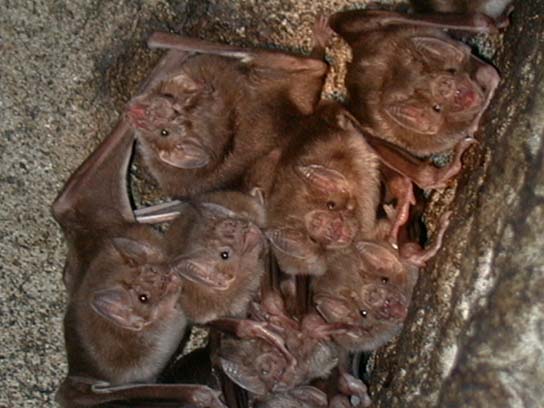
“Okay, what do we learn to imitate next?”
(Via: conservationcentre.org)

Far from being mindless, aggressive little monsters, vampire bats are altruistic, intelligent creatures. How intelligent? Researchers who housed a vampire bat with a hen observed the bat to mimic the behaviour of a chick so effectively that the hen settled down on top of the bat as she would to keep a baby warm. The bat then nicked her on the stomach and drank her blood while she tried to mother it.

Now that’s just creepy.

[Fun Fact: Vampire bats listen to the rhythm of an animal’s breathing to determine whether or not it’s asleep. They prefer to return to a victim they’ve had previous success with, and evidence suggests that they can identify individual humans by their breathing noises in the same way that we recognise individuals by their voices.]

[Also: The common vampire bat can jump up to three feet off the ground to reach large prey.]

Says Who?

  • Groger & Wiegrebe (2006) BMC Biology 4:18
  • Lee et al. (2012) PloS ONE 7(8): e42466
  • Schutt (2008) Natural History, November Issue, pg.22
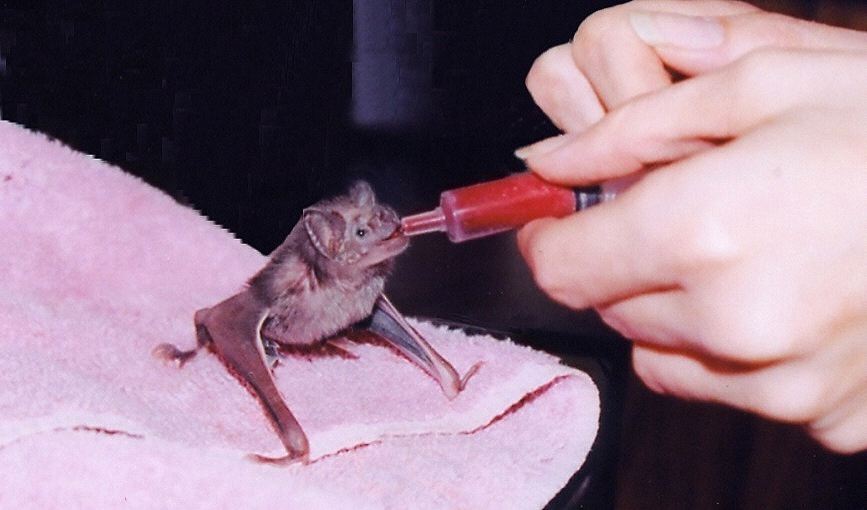
Become a donor today!
(Via: Vampire Legends)

Necessity is the Mother of Invention, or, How to Eat Like a Shrike

(By: Arthur Morris, Via: Livebooks Blog)

Common Name: The Shrike

A.K.A.: Family Laniidae

Vital Stats:

  • Family consists of three genera and around 30 species
  • Shrikes range in size from 17cm (6.5”) up to 50cm (20”) long
  • Feathers may be black and white, cream, grey, or brown

Found: Various species found in North America, Southern Africa, and Eurasia

It Does What?!

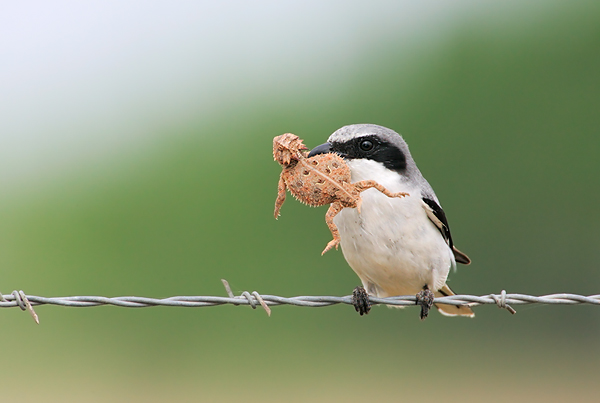
Sometimes a creature aspires to a spot a little higher on the food chain, but doesn’t quite have all the equipment to get there. Behold the shrike, the bird that wishes it were a raptor. Like birds of prey, shrikes have strong, hooked beaks, sharp eyes, and an appetite for meat, but they’re missing a couple of important features. First, and most important… no talons. Shrikes can’t grab a victim and tear it into pieces like a hawk or falcon could. And second, no crop (a sort of internal storage pouch), so they can’t eat a large quantity of meat in a single sitting.

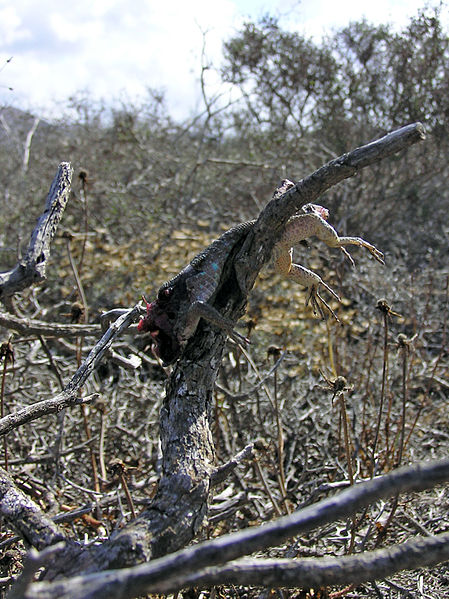
Not to be deterred by their anatomical shortcomings, these inventive go-getters have come up with a single solution to both problems. Two birds with one stone, if you will. After dispatching their prey with a quick beak to the back of the neck, shrikes will carry the carcass to a nearby shrub and actually impale it on a short branch or thorn. Aside from looking incredibly badass, this serves to anchor the body in one place, allowing the shrike to use its beak to rip the meat into pieces. What’s more, the bird can just leave its leftovers hanging there for later, like the meat locker at a butcher shop. [Wondering what that looks like? Here’s a video, set to appropriately ominous music.]

And now they’re learning to use human technology…
(Via: Nature Saskatchewan)

What kind of prey are we talking about here? Anything from small insects right up to mice, frogs, lizards, and other birds. There’s even a record of one killing and impaling a good-sized bat. Impressively, shrikes have also hit on the value of ageing their food – one species hunts the toxic lubber grasshopper of the southern United States. The dead grasshoppers are then left hanging for several days to let the poison degrade before being eaten. Clever birds.

Shrikes are monogamous and share in parenting duties; when the female is sitting on eggs, it’s the male’s job to go out and kill something nutritious for two. Of course, this makes selecting a good hunter an important task for females during mate selection. When a single male wants to advertise his skills, he makes a conspicuous display of his biggest, most impressive kills for any prospective ladies. Once he’s gotten one’s attention, he performs a mating dance that mimics the action of impaling prey on branches and then feeds her from his assortment of carcasses. (Be sure to include this point next time you’re explaining ‘the birds and the bees’ to someone.)

The owner of this lizard is probably off getting lucky.
(Via: Wikimedia Commons)

I guess when you have only one major skill, you want to make the most of it, because aside from eating and attracting mates, shrikes also use their impaling trick for communication. Bonded pairs are territorial and will defend their terrain from others of their species. In a sort of macabre message to would-be trespassers, the couple will mount their kills around the borders of their land, perhaps in an effort to show others what could become of them if push came to shove. (Did I mention these things actually have a comic book monster named for them? Eat your heart out, Batman.) Unfortunately for them, researchers note that this action often resulted in the prey being snatched by opportunistic passers-by and having to be replaced. It’s so hard to look murderous when everybody keeps stealing your victims…

[Fun Fact: Shrikes with young chicks will often eat only the head of their prey, saving the bodies for the kids. ‘Cause that’s just good parenting.]

Says Who?

  • Keynan & Yosef (2010) Behavioural Processes 85: 47-51
  • Sarkozi & Brooks (2003) Southwestern Naturalist 48(2): 301-303
  • Smith (1973) Behaviour 44(1/2): 113-141
  • Yosef & Pinshow (2005) Behavioural Processes 69: 363-367
You’re next.
(Via: Tough Little Birds)

The Cost of Eighty Million Years in Paradise

(Via: The Life of Animals)

Common Name: The Kakapo, The Owl Parrot

A.K.A.: Strigops habroptila

Vital Stats:

  • Males can grow up to 60cm (24”) long and weigh up to 4kg (8.8lbs.)
  • Average life expectancy of a healthy kakapo is 95 years
  • Breeding begins around age 9; females lay 1-3 eggs per clutch
  • Main mammalian predators are rats, cats, ferrets, and weasels

Found: Traditionally, across large areas of both major islands of New Zealand; today, mostly on small, protected island reserves nearby

It Does What?!

Strange things happen when you leave a few species alone on a distant island for a few million years. Places like New Zealand, Australia, Madagascar, and Hawaii are (or were) full of plants and animals that seem alien compared to rest-of-the-world standards. This is often due to a set of conditions and evolutionary challenges unlike those seen on the continent. Life on New Zealand is particularly interesting, having been heavily shaped by the fact that the only terrestrial mammals there are bats. Every animal that evolved there did so without the pressure of having to avoid toothy predators stalking them through the forest. Ever wonder what birds would be like without anything on the ground trying to kill them?

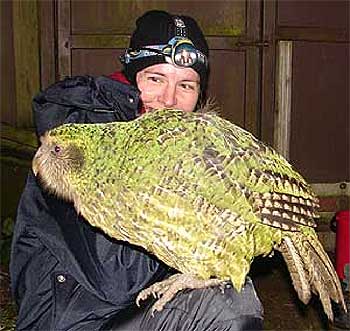
“I’m just big boned, okay?”
(Via: Gothic Atheist)

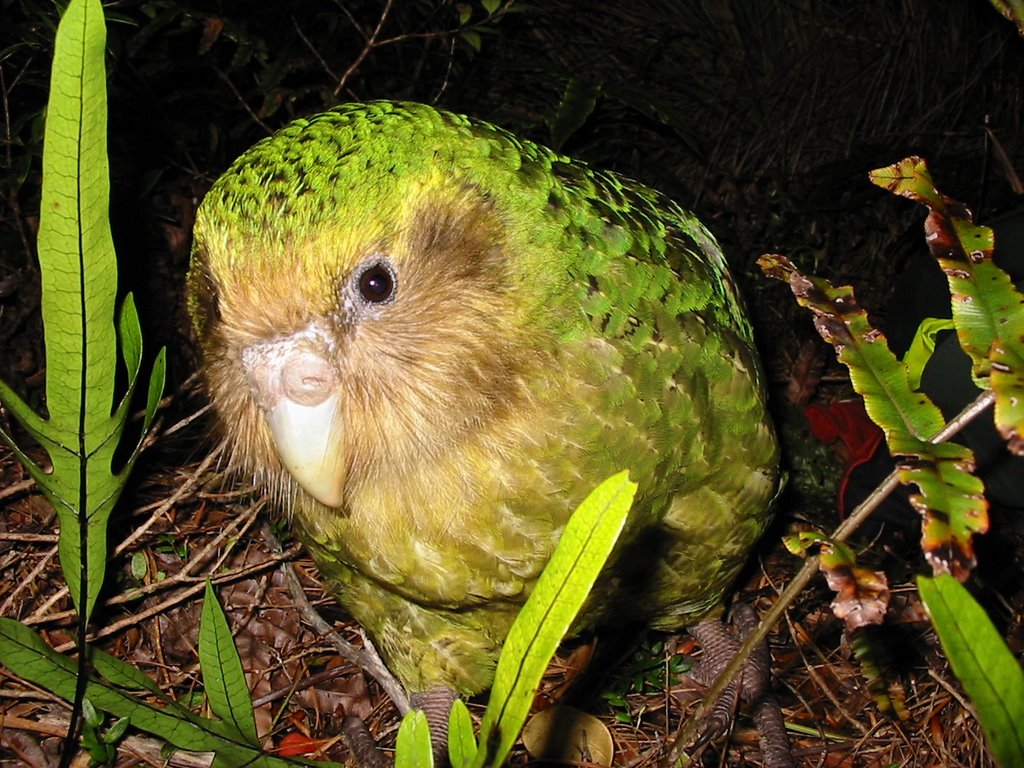
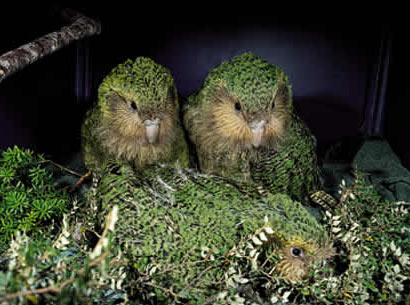
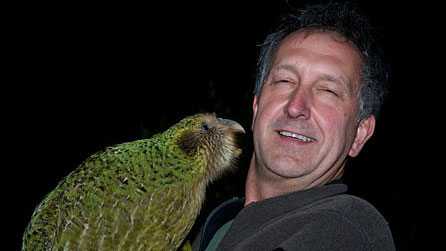
If so, meet the kakapo, the world’s largest, fattest parrot. And the only one that can’t fly. Isolated in New Zealand when the islands separated from the continent over eighty million years ago, the native parrots eventually lost their strong flight muscles and stiff, rigid wing feathers, trading them for greater size and the ability to store a half inch thick layer of fat under their skin to sustain them in lean times. This change also slowed their metabolism, resulting in their being one of the longest-lived birds out there, with a maximum recorded age of 120 years. Slothlike, these peaceful, nocturnal creatures spend most of their waking hours climbing (yes, climbing) from tree to tree, eating fruit and foliage. Unlike sloths, however, they can take a quicker route down, simply leaping from the tree and spreading their stumpy wings in what’s probably a very amusing imitation of a parachute. Unsurprisingly, they’ve developed quite strong legs, and can cover distances of several kilometres at a jog.

The most fascinating aspect of the kakapo lifestyle, though, has to be its mating routine. Unlike most parrots, kakapos aren’t monogamous and don’t share parenting duties. Every three to six years, when fruit crops are particularly good, male kakapos will stake out a small territory on high ground, fighting with other males for the best spots. The “best spots” in this case being those with the best acoustic qualities, such as those backed by a rock wall which can reflect sound outward over the land. Having obtained his mating area, he will construct a series of pristine paths leading up to it (for the ladies), as well as a large bowl-shaped depression in the earth, which acts as an amplifier. Kakapo-sound-system completed, he’s ready to get down to business. The male stands in his bowl, inflates a sac in his chest, and emits a series of eerie, low frequency booms, like distant cannons, loud enough to be heard several kilometres away. He continues to do this, all night, every night, for up to four months, losing up to half his body weight in the process. The female kakapo has it somewhat easier. She simply approaches the emitter of her favourite booms, he performs a short dance routine for her, she gets what she came for, then walks on home to lay her eggs.

“I could hide better if you two would quit staring.”
(Via: Pour L’animal)

Before the colonisation of New Zealand, the islands were reportedly teeming with these birds, so successfully specialised were they for their unusual environment. Their only natural predators were birds of prey, from which they hid by freezing and blending into the surrounding greenery. Sadly, specialisation is often a one-way street that you can’t back out of if your environment suddenly changes. The features that made the defenseless kakapos good at avoiding avian predators (like their tendency to freeze), made them terrible at avoiding the carnivorous mammals, such as cats, that came with colonisation. Despite having powerful legs with large claws, the birds seem unaware that they can be used as weapons. Worse, their natural curiosity and lack of fear in approaching humans often landed them on both Maori and European dinner tables.

Enormous efforts have been made over the last century to prevent these big, gentle birds from going extinct. As of this year, there are still only 126 known to exist (each with its own name and radio transmitter), but they are a slowly expanding population, thanks to their relocation to three protected, largely predator-free islands. Expectant mothers even have their own nest watchers, who sneak in to cover the nests with electric blankets while mom pops out for a bite. Free babysitting- seems like the least we can do.

“How do YOU like it?!”
(Via: BBC’s Last Chance to See)

[Fun Fact: Conservationists have had to scale back on the supplemental food they had been giving the kakapos during mating season. It turns out a well-fed kakapo will produce mostly male chicks. Not what you need when you’re trying to rebuild a population.]

[Also: Kakapos use their fine facial feathers like whiskers, walking with their faces near the ground to sense the terrain.]

Says Who?

  • Douglas Adams & Mark Carwardine (1990) Last Chance to See. Pan Books, London [This is a fantastic book. Highly recommended.]
  • Grzelewski (2002) Smithsonian Magazine, October Issue
  • Sutherland (2002) Nature 419: 265-266

Pitcher Plants: Sweet Temptation and the Slippery Slope

(Via: Wikimedia Commons)

Common Name: The Asian Pitcher Plant

A.K.A.: Genus Nepenthes

Vital Stats:

  • Over 130 species in the genus
  • The vast majority of species have extremely narrow ranges of only a single island or small island group, and are considered threatened
  • Most recently discovered (2007) was Nepenthes attenboroughii, named for Sir David Attenborough, who is fond of pitcher plants

Found: Mountainous regions of Southeast Asia, Oceania, and Madagascar

It Does What?!

Plants have evolved a variety of different ways to deal with growing in nutrient-poor soils. Some become parasitic, some develop close symbiotic relationships with bacteria or fungi, and some of them… well, some of them just start eating animals.

Lizard: makes a nice, light snack.
(Via: Wikimedia Commons)

One group of plants that went this route are the Asian pitcher plants (not to be confused with the not-closely-related New World pitcher plants, which tend to have tall, flute-like pitchers). These smallish, climbing plants use highly modified leaves to form what are essentially external stomachs, complete with the plant’s own digestive fluid. These pitchers, which vary in size from one species to the next, have extremely slick, waxy inner walls. When visitors come to eat the nectar produced on the lid (or “operculum”) of the trap, they lose their footing and fall into the liquid below.

That liquid is actually a pretty complex mixture; it’s divided into two phases, like oil and water. The upper portion is mostly rainwater, but has been laced with a compound that makes it more viscous, preventing winged insects from just flying away, as they could from pure water. The trap’s lid actually functions to prevent too much rainwater from getting inside and diluting the fluid too much. The lower portion of the liquid is a digestive acid capable of breaking down flesh into useable molecules (particularly nitrogen and phosphorous), much like our own stomach acid. Analogous to our intestines, the lower inside surface of the pitcher is covered with special glands that absorb suspended nutrients.

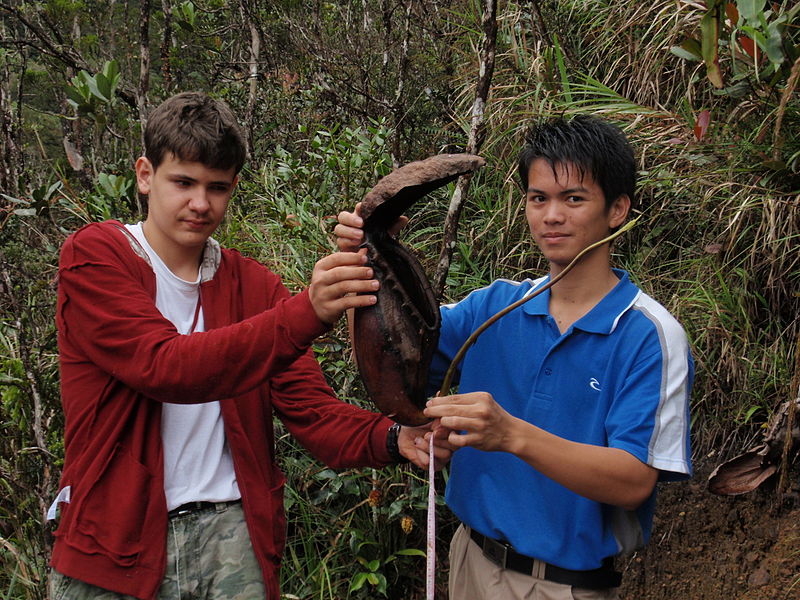
Most of what gets caught in pitcher plants is about what you’d expect- winged insects, spiders, beetles, small scorpions. But occasionally, some larger animals find their way in. Things that should have known better, like frogs, lizards, and even birds. Arguably, these plants are doing evolution a favour by taking out any bird dumb enough to fly into its own watery grave. And yes, to answer your next question- they can eat rats, but only a single species has been documented to do this. Nepenthes rajah, the largest of all pitcher plants, has pitchers which grow to a height of nearly half a metre (1.6’) and hold up to three and a half litres (1gal.) of fluid, most of which is digestive juice.

Interestingly, pitcher plants have formed symbiotic relationships with several of the same types of creatures that it otherwise preys on. Nepenthes lowii, for example, provides nectar to a tree shrew. Instead of falling in and being digested, the shrew treats the pitcher as its personal toilet, thereby providing the plant with most of the nutrition it requires.

In one end and out the other.
(Via: Wikimedia Commons)

Other species form alliances with groups of carpenter ants. In exchange for a steady supply of nectar and a place to live- in this case a hollow tendril- the ants basically act as the plant’s evil henchmen (apparently a specialty of ants). When prey that is too large to be easily digested falls into the trap, the ants remove it, rip it to shreds, and then throw the bits back in again.

How’s that for a brilliant piece of evolution? Not only did these plants grow an external stomach… they get ants to chew their food for them.

[Fun Fact: Some pitcher plants primarily survive by digesting leaves that fall from trees into their traps – the ‘vegetarians’ of the carnivorous plant world.]

Says Who?

  • Bonhomme et al. (2011) Journal of Tropical Ecology 27: 15-24
  • Clarke et al. (2009) Biology Letters 5: 632-635
  • Krol et al. (2012) Annals of Botany 109: 47-64
  • Robinson et al. (2009) Botanical Journal of the Linnean Society 159: 195-202
  • Wells et al. (2011) Journal of Tropical Ecology 27(4): 347-353
So big it makes them vaguely uncomfortable.
(Via: Wikimedia Commons)