The Plant That Time Forgot (Welwitschia mirabilis)

(Via: Wikimedia Commons)

Common Name: Welwitschia mirabilis

A.K.A.: Welwitschia

Vital Stats:

  • Welwitschia is a gymnosperm, like pines or firs, and thus reproduces via male and female cones
  • Considered a “living fossil”
  • Named after one of its discoverers, Austrian botanist Friedrich Welwitsch
  • In mature specimens, the woody stem can grow up to one metre (3.3’) across

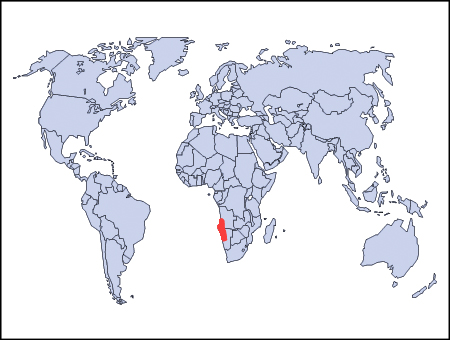
Found: In the Namib desert, along the west coast of Namibia and Angola
It Does What?!

Restricted to a tiny, arid swath of African desert, Welwitschia mirabilis represents the last remaining species of a very unusual lineage of plants. Close relatives met with extinction over the aeons, while welwitschia, tucked away in its remote and harsh desert range with little competition, just kept going. The fact that the species is alone, not just in its genus, but also in its family and order (the two ranks above genus in plant systematics), speaks to just how distantly related to any other living plant it is. For the sake of comparison, the Rosales, the order to which roses, apples, and pears belong, contains around 7700 species in 9 families and 260 genera. So original and captivating is welwitschia among plants that it has been the subject of more than 250 scientific articles since it was first described in 1863.

A mere infant. But probably still older than you are.
(Via: Lizworld.com)

So what makes this thing so weird? Well, plants typically have what’s called an apical meristem at the tips of their stems and/or branches. You can think of this as a clump of stem cells that keeps dividing, throwing off new leaves and buds in its wake. If you cut off the apical meristem, the plant must either develop a new one elsewhere, or stop producing new tissue.

In welwitschia, this isn’t the case. At the beginning of the plant’s life, the apical meristem produces just two leaves, and then dies. The plant will never grow another leaf, which is much more surprising when you consider that it may well live for more than a thousand years. How do you get through a millennium with only two leaves?! The answer is, these aren’t ordinary leaves. Uniquely, welwitschia’s two strap-like leaves have a band of meristematic tissue built into their base, which means they can continue to elongate outward indefinitely. The leaves will continue to grow at a rate of around half a millimetre (0.02”) per day for as long as the plant lives. If you’re thinking that this must mean leaves that are several hundred metres long, unfortunately, no, they aren’t. The leaves are abraded away by sand storms and eaten by passing animals. Even in the best case scenario, the cells at the leaf tips have a maximum lifetime of about ten years (still pretty good for a leaf…). What’s more, the leaves tend to get frayed and split over time, and end up looking like a lot more than just two leaves. Despite all the punishment, though, each leaf can reach a length of up to four metres (13’), giving a mature welwitschia a width of up to eight metres (26’) across.

Welwitschia’s answer to the pinecone.
(Image by Friedrich A. Lohmuller)

As you might expect from a long-lived relic of the past, there aren’t a lot of these plants around. For once, this has less to do with human disturbance than natural circumstances. Over millions of years, the range where welwitschia grows has dried out considerably, and in fact continues to get drier even now. Today, the plant relies largely on fog to meet its water needs, restricting its range to a thin strip of desert coastline where fogs occur regularly. Unlike cactuses or succulents, welwitschia has never evolved the ability to store water. Also problematic is a fungus, Aspergillus niger, which frequently infects and destroys germinating seeds. These factors together can mean that a welwitschia colony can sometimes go many years without successfully reproducing.

And of course, no threatened species would be complete without some human interference. In recent decades, unscrupulous collectors have removed plants from already small breeding populations, making it even more difficult to sustain their numbers. Interestingly, it’s noted in Wikipedia that plants in Angola are actually better protected from collecting than those in Namibia due to the higher concentration of landmines there.

So… landmines: bad for humans, good for endangered plants.

You think you have problems with split ends?
(Via: Natural History Museum)

Says Who?

  • The Gymnosperm Database
  • Dilcher et al. (2005) American Journal of Botany 92(8):1294-1310
  • Henschel & Seely (2000) Plant Ecology 150:7-26
  • Jacobson & Lester (2003) Journal of Heredity 94(3):212-217
  • Rodin (1958) American Journal of Botany 45(2):96-103
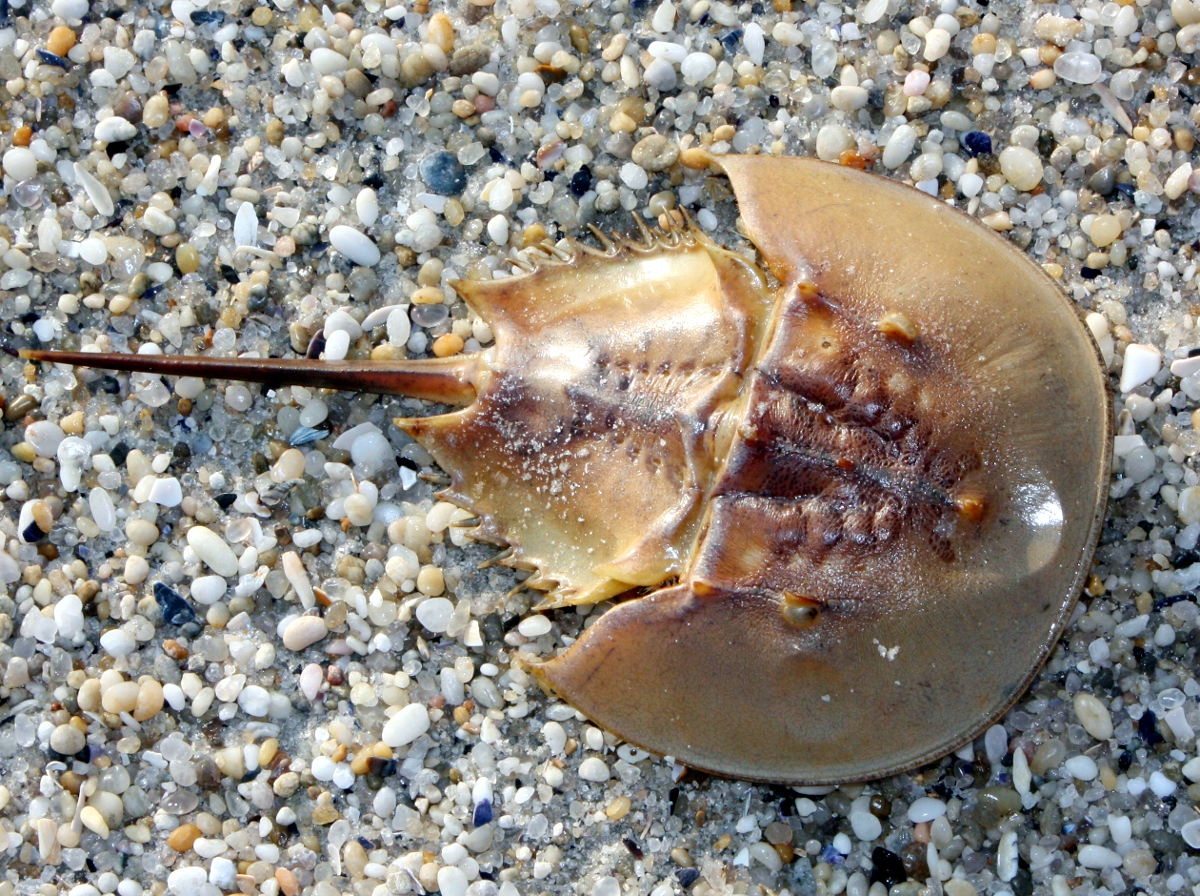
Thank a Horseshoe Crab

(Via: reefguide.org)

Common Name: Horseshoe Crab

A.K.A.: Family Limulidae

Vital Stats:

  • Four extant species of horseshoe crab in three genera (Limulus, Carcinoscorpius, and Tachypleus)
  • Females are larger than males, and can reach up to 60cm (24”) long in some species
  • Believed to live between 20 and 40 years

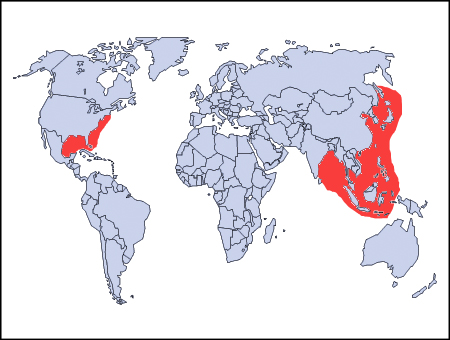
Found: Coastal waters of southeast Asia, Oceania, and eastern North America

It Does What?!

Like the platypus and the lungfish, horseshoe crabs are what biologists refer to as “living fossils,” meaning their basic form has gone essentially unchanged for many millions of years. In the case of horseshoe crabs, fossils as old as 445 million years have been found that are quite similar to the extant species of today.

Despite their common name, the Limulidae aren’t true crabs. They’re arthropods, like crabs, but are actually more closely related to spiders and scorpions. In fact, beneath that tough shell, they do look quite spider-like. If spiders had tails, that is.

Basically a tarantula in combat gear.
(Via: Wikimedia Commons)

Horseshoe crabs live in shallow coastal waters, feeding off worms and molluscs from the ocean floor. They are able to feed in near complete darkness at night due to a remarkable visual system. The creatures have three different types of eyes – compound, median, and rudimentary – located to both sides and to the front of their shell. What’s more, their compound eyes become a million times more sensitive to light at night than they are during the day. Since that’s roughly how much less light they have to work with at night, the crabs are able to see equally well at night and during the day.

Most people who have observed horseshoe crabs know them from their unusual breeding habits. Each spring and early summer, male crabs will search out a mate and attach themselves to the female’s shell using a special modified leg. Then, during the highest tides of the year, usually at night, the females crawl up onto shore by the hundreds, carrying their male cargo. Having picked a spot that’s moist, but not so low as to be washed away with the tide, they dig a nest into the sand and lay their eggs. The attached males get first dibs at fertilising the pre-laid eggs, but must share the task with numerous mate-less onlookers who rush in to get their shot at fatherhood as well (crabs are so uncouth). Since eggs number in the tens of thousands per female, many will probably be successful. Most of these thousands of eggs, however, will become food for migratory birds, who appreciate the extra protein snack on their long journeys. After a month or so, the uneaten eggs will hatch into larvae, which remain on the beach in groups for a couple of weeks before moulting into juvenile horseshoe crabs and finally moving into the water.

Horseshoe crabs, making more horseshoe crabs.
(Via: Wikimedia Commons)

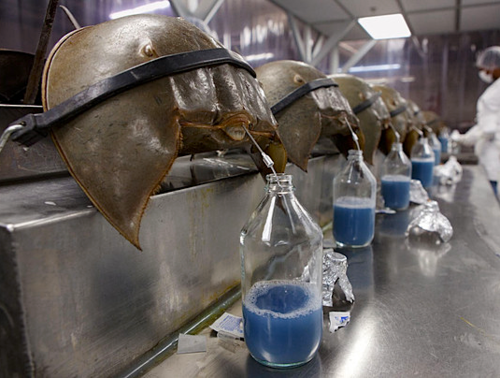
Now you might be thinking, “That’s all well and good, but what can horseshoe crabs do for me?” Well, as it turns out, these creatures are some of the most prolific blood donors on Earth (whether they like it or not). Like our friend Mr. Spock, horseshoe crabs have copper-based blood, rather than the iron-based concoction favoured by humans. They are literally blue-blooded. And instead of white blood cells to fight off infection, they have amebocytes. These amebocytes are so valuable in detecting certain types of bacterial infections in humans that a quart of horseshoe crab blood is worth approximately $15,000 US. Crabs are caught, transported to a lab, and drained of about 30% of their blood before being released. The company behind this 50 million dollar per year industry states that only about 3% of the quarter million crabs die from the procedure annually, while other studies have found the number to be nearer to 15% (read more about it here). Knowing who’s right may become very important, as horseshoe crab populations are declining worldwide, additionally affecting the migratory birds that feed on their eggs. Either way, next time you survive an E. coli infection, thank a horseshoe crab.

No, no… we don’t mind. Really.
(Via: TYWKIWDBI)

[Fun Fact: Horseshoe crabs are thought to be the closest living relative of the extinct trilobite.]

[Also, here’s a cool video of (who else?) Sir David Attenborough explaining the mating habits of horseshoe crabs.]

Says Who?

Ergot: Bringing the Crazy Since 800 A.D.

(Via: The University of Illinois Extension Collection)

Common Name: Ergot, Ergot of Rye

A.K.A.: Claviceps purpurea (and other Claviceps species)

Vital Stats:

  • Around 30-40 species in genus Claviceps, all parasites of various types of grasses
  • Parasitizes rye, barley, and wheat crops in temperate regions
  • Problematic in Africa due to its parasitism of sorghum and millet

Found: Throughout temperate and tropical regions, though historically most problematic in Europe, Africa, and North America

It Does What?!

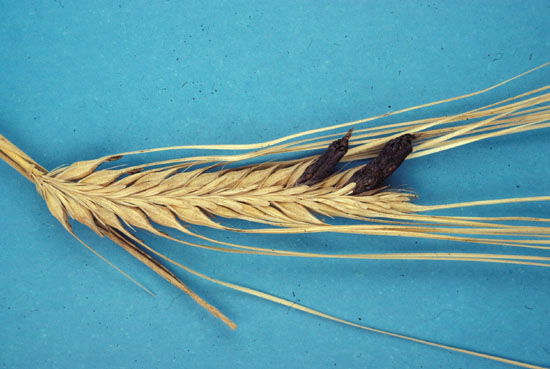
Disrupts human history and generally scares the hell out of people, to put it mildly. But before we get into that, let’s start with what this stuff is. An ergot infection begins when a microscopic fungal spore lands on the open floret of a grass plant. In northern agricultural areas, rye and, to a lesser extent, barley are particularly susceptible to these spores. Once on the receptive flower, the spore behaves as though it were a pollen grain, growing down the style until it reaches the ovary. At this point, it destroys the ovary and links into the adjoining vascular tissue, where it can parasitize the plant for nutrients.

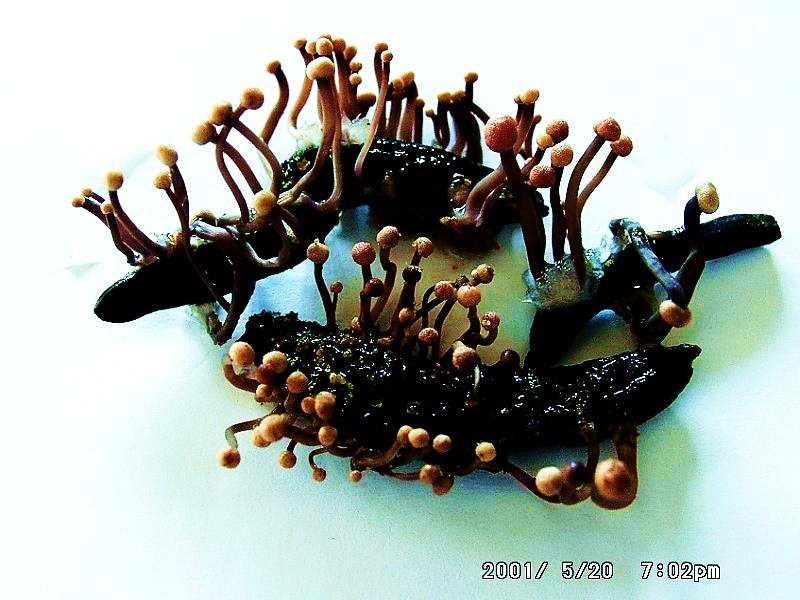
With plenty of food on tap, the fungus grows into the space that the grain would have otherwise filled. Early on, it forms into a soft, white mass that causes a sugary liquid to drip from the flower. This liquid is filled with spores and is spread to other plants by hungry insects as they fly from flower to flower. Later in the growing season, around the time neighbouring non-parasitized grains are ripening, the fungal mass dries and hardens into a sclerotium (a sort of fungal seed body) that looks a bit like wild rice, and drops to the ground. This sclerotium will sit dormant on the ground until spring, when moisture will cause it to sprout small mushrooms, which produce spores for the new season.

Hint: Wild rice doesn’t do this when you get it wet.
(Via: mycotopia.net)

Still reading? Good. Here’s the interesting part. Let’s say you’re a farmer in the Middles Ages, and the infected plants in question are in your field. Before the ergot sclerotia drop to the ground, they get harvested with the rest of the crop, and end up getting made into bread for you and your family. Well, it turns out those sclerotia are full of a toxic alkaloid called ergotamine, and after eating enough loaves of bread to build the compound up in your systems, you and your nearest and dearest have contracted ergotism. Fed some of that rye to your cows? Now they’ve got it, too!

Ergotism delivers a one-two punch of physical and psychological symptoms. Physically, the alkaloid constricts blood vessels, leading to an intense burning sensation in the arms and legs which can eventually cause gangrene and loss of the entire limb. Some sufferers also develop a persistent ringing in the ears. That’s before the seizures and untimely death set in. Psychologically… well, it makes you crazy. As in, hallucinations and irrational behaviour, which lead many victims to be ostracised by their communities. Ergotism is speculated to have been the cause of the Dancing Mania (not as fun as it sounds) that hit Europe in the Middle Ages. Huge numbers of people were struck by an uncontrollable urge to dance – violently and while screaming – until they collapsed from exhaustion. Did I mention that this stuff is where LSD came from? The drug was originally synthesised from ergotamine, handily delivering all the craziness with none of the gangrenous limb loss.

Nope, nothing suspicious-looking here.
(Via: Wikimedia Commons)

The cure for all this horror? Well, if you got to it early enough, simply not eating any more contaminated grain would cause symptoms to slowly abate. Unfortunately for medieval peasants, who ate a lot of rye and suffered most of history’s outbreaks, the cause of the disease was completely unknown. Weird-looking sclerotia were so common that they were thought to be a natural feature of rye. That old standby, “It’s the wrath of God” actually seemed supported, since sufferers who left the affected area on pilgrimages immediately began to show improvement (hence another term for the disease, ‘Holy Fire’). Sadly, it took the better part of a millennium before someone worked out what was really going on, and major outbreaks occurred right up to the 19th century. Even in the 21st century, minor outbreaks have occurred in developing countries, such as the case in Ethiopia in 2001, caused by infected barley.

Speaking of disrupting human history, some researchers have speculated that an ergotism outbreak caused the strange behaviour that resulted in the Salem witch trials of the late 17th century. Others have disputed this claim, noting, among other points, that ergotism was known and recognisable by this point in history. We may never know for sure.

[For other historical events in which ergotism may have played a role, check out the first reference below.]

[Fun Fact: Due to its action as a vasoconstrictor, ergotamine is now used, in purified form, to treat migraines and post-natal bleeding.]

Says Who?

Randomly Assembled and Surprisingly Dangerous: The Platypus

(Via: National Geographic)

Common Name: The Duck-Billed Platypus

A.K.A.: Ornithorhynchus anatinus

Vital Stats:

  • Only species of Family Ornithorhynchidae
  • Males average 50cm (20”) long, females 43cm (17”)
  • Weigh between 0.7 and 2.4kg (1.5 – 5.3lbs.)
  • Body temperature of 32 degrees Celcius; five degrees lower than placental mammals
  • Live up to 17 years in captivity
  • Eat freshwater crustaceans, worms, and insect larvae

Found: Eastern Australia and Tasmania

It Does What?!

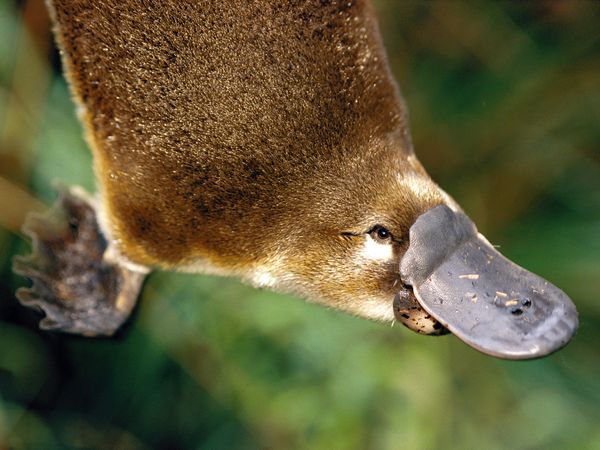
Besides looking like it was assembled from spare parts? We’ve all seen pictures of platypuses (yes, “platypuses”, not “platypi”) before, and everyone knows what total oddities they are: the duck-like bill, the beaver-esque tail, the fact that they lay eggs, despite being mammals; but behind these weird traits lie… even more weird traits! So let’s take a moment to appreciate the lesser-known eccentricities of the platypus, shall we?

First off, these cuddly looking freaks are actually dangerous. Male platypuses have a spur on each hind foot which is filled with a venom powerful enough to kill a large dog. While it isn’t enough to take out a human, it does cause severe, incapacitating pain whose after-effects can last for months. One of only a very few venomous mammals, the male’s venom production increases during the breeding season, suggesting its purpose may lie in competition with other males.

Why your dog and your platypus shouldn’t play together.
(By Jason Edwards, via: How Stuff Works)

And speaking of breeding, reproduction in platypuses isn’t exactly ‘mammal standard’, either. Unlike all other mammals, which have two sex chromosomes (X and Y; XX for females, XY for males, with rare exceptions), the platypus has ten. Talk about evolutionary overkill. A male platypus has the pattern XYXYXYXYXY, while a female has ten Xs. Researchers have found that the actual genetic structure of these sex chromosomes is actually more similar to birds than mammals, although 80% of platypus genes are common to other mammals.

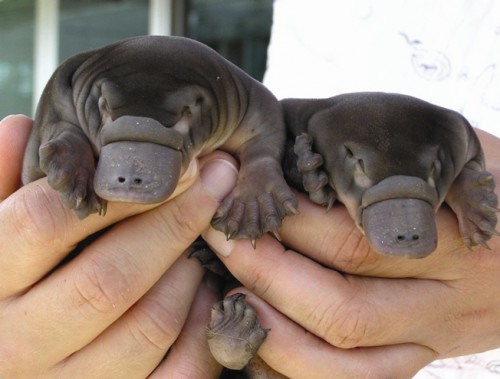
After this alphabet soup of chromosomes arranges itself, up to three fertilised eggs mature in utero for about four weeks; much longer than in most other egg-laying species (in birds, this may be only a day or two). Once laid, the eggs are only about the size of a thumbnail, and hatch in around ten days. While platypuses produce milk, they don’t actually have proper teats to suckle their babies- the fluid is released from pores in the skin. A small channel on the mother’s abdomen collects the milk, which is then lapped up by the young. Strangely, the babies are actually born with teeth, but lose them before adulthood. Such is the impracticality of platypus design…

Adorably impractical.
(Via: noahbrier.com)

Finally, let’s explore platypus hunting methods. Platypuses are the only mammals with the sixth sense of electroreception. Those leathery duck bills of theirs are actually precision receptors that can detect the electric fields created in the water by the contractions of muscles in their prey. Considering the prey in question is largely worms and insect larvae, we’re talking big-time sensitivity here. The bill is also very receptive to changes in pressure, so a movement in still water can be picked up in this way as well. Researchers have suggested that by interpreting the difference in arrival time of the pressure and electrical signals, the hunter may even be able to determine the distance of the prey. This would be especially useful, given that platypuses close both their eyes and ears when hunting. In fact, they won’t even eat underwater; captured food is stored in cheek pouches and brought to land to be consumed.

So there you have it. The platypus: even weirder than you thought.

[Fun Fact:The female platypus has two ovaries, but only the left one works.]

Intelligent Design’s Worst Nightmare
(Via: Animal Planet)

Says Who?

  • Brown (2008) Nature 453: 138-139
  • Grant & Fanning (2007) Platypus. CSIRO Publishing.
  • Graves (2008) Annual Review of Genetics 42: 565-586
  • Moyal (2002) Platypus: The Extraordinary Story of How a Curious Creature Baffled the World. Smithsonian Press.